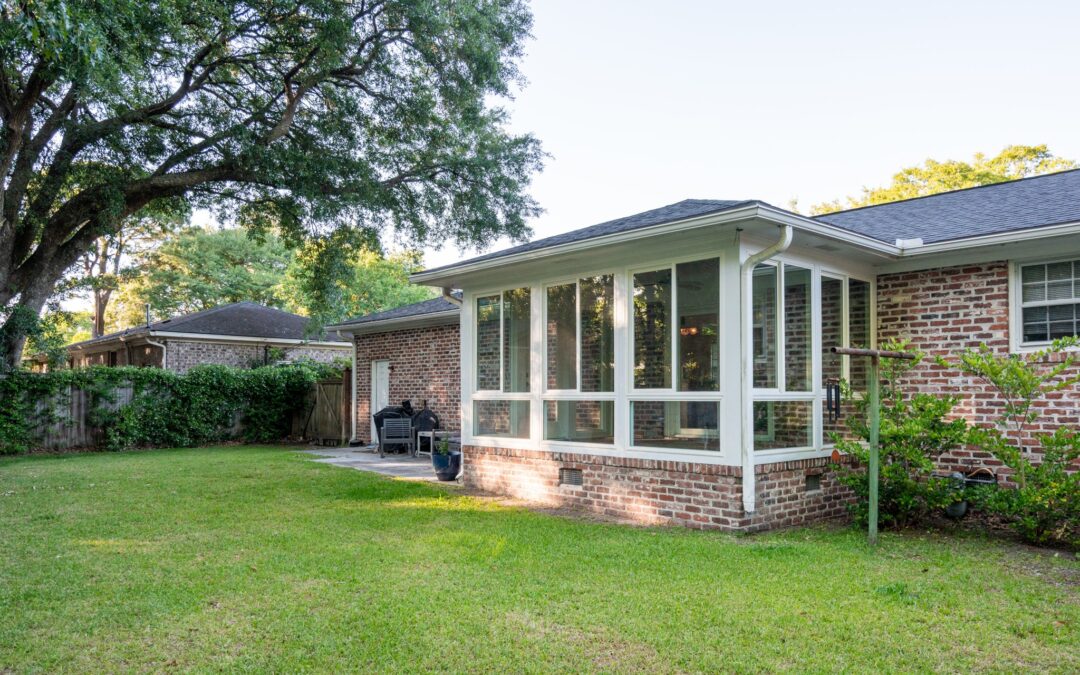
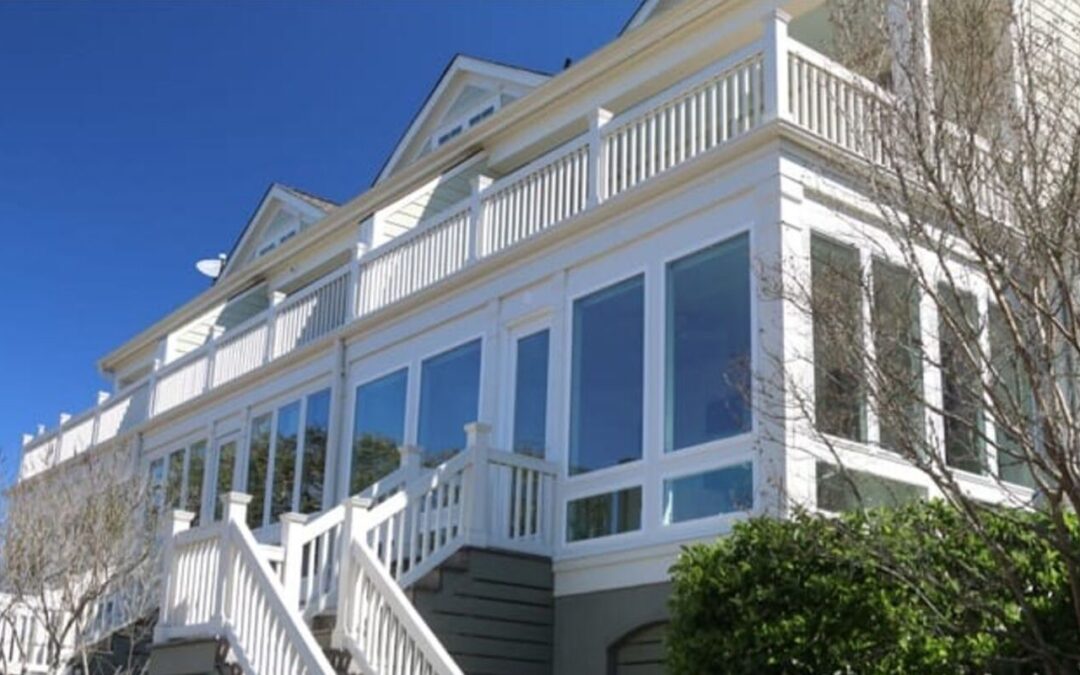
Sunroom & Porch Enclosure Guide — Charleston, SC
Screen is for air and insects; rigid acrylic panels stop pollen, rain and wind in a three-season room; insulating glass is for a conditioned, year-round room. In the Lowcountry, durability is decided by UV, salt air and summer heat, and by whether the frame takes new panels without rebuilding. Muhler builds its welded vinyl Any-Season Room frame in North Charleston.
The Lowcountry tests more than the panel: sun, salt on the hardware, humidity in a closed room, pollen and rain and, in a storm, flying debris. Here is how the three sunroom enclosure materials answer each, and why the frame matters as much as the panel.
1. What the Lowcountry does to a porch enclosure
Sun and heat. Summer heat and humidity are the binding constraint here, and an unconditioned closed room feels them most. Ultraviolet is the slower test: it is why the acrylic sheet in a panel matters, and why clear glass should not be assumed to filter it.
Salt. Salt air works on metal: fasteners, anchors, tracks, hinges and latches. Coastal work specifies corrosion-resistant hardware, and a freshwater rinse that keeps tracks and hinges from seizing is real maintenance here.
Humidity. A closed panel room needs moving air on humid nights, or it risks condensation and mildew.
Pollen and rain. The spring pollen dump is a reason people close in a screen room later, and the afternoon storms test every opening.
Wind-borne debris. This is a 130-plus mph design-wind coast, and parts of it lie inside the wind-borne debris region, where glazed openings must be impact-rated or protected. Whether your address is inside it is a code-map question for your building department.
2. Screen: what it keeps out and what it does not
A screen room sets screen panels or a screen-wall track system between the existing posts, under the existing roof. It adds negligible weight but still needs a sound roof and posts. The mesh is the real decision:
- Standard fiberglass mesh.
- Tighter 20×20 “no-see-um” mesh for the Lowcountry’s biting midges.
- Pet-resistant mesh for households with pets.
- Solar or shade screen, which cuts UV and some heat gain.
Screen has no thermal value: the room tracks the outdoor temperature and humidity, and its comfort leans on shade, orientation and ceiling fans. It keeps insects out but does not stop wind, rain or the spring pollen; that is the job of panels.
On a historic peninsula piazza, screening the Board of Architectural Review’s way is the realistic path, and its policy reaches materials: generally flat black or painted to match, and no aluminum screening. No one can promise a board’s decision.
3. Rigid acrylic panels: UV, airflow and the greenhouse effect
Rigid acrylic panels set into the openings make a three-season room. They stop wind, rain and the spring pollen dump, add essentially no insulation, and leave the room unconditioned.
Without ventilation or an exhaust path, a closed acrylic room bakes in afternoon sun, the greenhouse effect at work; without airflow on humid nights it risks condensation and mildew; in a cold snap it needs space heat. So ask about air: which panels open, where air enters and leaves, and where a ceiling fan goes.
UV resistance depends on the sheet. It is documented sheet by sheet, not for acrylic in general, so ask which sheet and grade your panels are cut from, and clean them the way its maker directs.
Acrylic is not vinyl. The common dealer alternative is a vertical four-track window system glazed with vinyl: the same job in the same bays, in a different material. In a porch-enclosure quote, “vinyl” can mean three different things: the vinyl glazing in those four-track systems, the welded vinyl frame of Muhler’s Any-Season Room, or the vinyl frames of the windows we install in its insulating-glass configuration; it never describes Muhler’s panels, which are screen, rigid acrylic or insulating glass.
4. Insulating glass: the conditioned room
A four-season glass room pairs insulating glass units, Low-E coated and argon filled, with insulated wall and roof panels and a dedicated heating and cooling system, typically a ductless mini-split sized by a load calculation.
Glass is also the heavy answer: on an ordinary porch, its dead load and the wind load of a closed box often mean rebuilt posts, knee walls or roof, as our guide to converting a screened porch into a sunroom explains.
Comfort rides on the glazing spec, a right-sized dedicated system, and orientation and shading, which are worth more than brute-force cooling. The summer number is SHGC, the share of the sun’s heat the glass admits; lower is cooler, so ask for the certified NFRC figures for the exact unit. In the Any-Season Room’s insulating-glass configuration, the windows we install are JELD-WEN vinyl-framed units with Low-E 366 glass and argon fill; the screen and acrylic configurations are not glazed with them.
Nor is glass automatically a UV filter: in one glass maker’s published table, a typical clear, uncoated double-pane unit passes more than half of incoming ultraviolet; laminated glass with a clear interlayer, essentially none. Ask for the UV figure of the exact glass. Weighing an unconditioned room against a conditioned one? See our 3-season vs. 4-season sunroom comparison.
5. Hurricane-rated choices: what the rating covers
A hurricane rating describes a tested assembly, not a material. ASTM E1886 is the test method: a missile strike, then cyclic pressure that simulates sustained hurricane wind. ASTM E1996 is the specification that sets which missile, by height and risk. ASTM’s scope for both covers exterior windows, doors and impact protective systems, so the rating belongs to the unit as tested, not to a sheet of glass or plastic.
For glazing within 30 feet of the ground, the large-missile test fires a 9-pound two-by-four at roughly 34 mph. A passing unit may crack, but it may not open: no tear longer than 5 inches and no hole a 3-inch sphere can pass. Impact-rated glass gets there with a laminated interlayer, a reinforced frame and certification testing. For a hurricane-resistant room addition, the page to read is the Any-Season Room: the enclosure system is “Available with Rated Hurricane Protection,” and what that covers is settled for your configuration and parcel.
On this coast, the three options sit differently:
- Fixed glass in the wind-borne debris region must be impact-rated to ASTM E1886 and E1996 or protected by a tested shutter or fabric system (see our storm protection options), and the enclosure walls need design-pressure ratings. Fixed glass has no gray area.
- Removable panel systems, acrylic or the vinyl four-track kind, are a gray area that jurisdictions treat differently: ask the building department how it treats removable panels before you buy.
- Screen is insect mesh, not storm protection; wind passes through it.
For the room itself, the Any-Season Room is “Available with Rated Hurricane Protection”; ask what that covers for your configuration and your address.
6. One frame, three panels: the Any-Season Room
Muhler’s Any-Season Room separates the panel from the frame. In the brochure’s words: “Our Any-Season Room Enclosure System uses the same welded vinyl frame for screen, acrylic, or glass rooms. A screen room can be upgraded to acrylic or glass by replacing only the panels within the existing frame.” The frame is designed from the start for the weight and wind loads of solid panels, which is how the openings can change “without rebuilding the structure.”
That is one start and one upgrade, a choice rather than a ladder: screen to acrylic, or screen to insulating glass. Nobody has to buy all three. The brochure’s own line for it is “One frame system. Multiple possibilities.” Its seasonal labels, as printed:
- Screen: “Spring & Summer Escapes”
- Acrylic: “Cozy Fall Comfort”
- Insulating glass: “Winter Retreats”
Those are Muhler’s labels; how a particular room feels still depends on orientation, shading, glazing and ventilation. The brochure also lists “Sliding windows for fresh air” and “Uninterrupted views,” and five color options: Clay, Beige, White, Black and Bronze.
Muhler’s patented Any-Season Room Enclosure System is engineered and assembled right here in North Charleston and sold factory direct: “We make it. We install it. You save.” Muhler makes the frame; the glass comes in the JELD-WEN windows we install. See the Any-Season Room page and our sunrooms and porch enclosures overview.
7. Sunroom enclosure materials side by side
Qualitative by design: the answer for one porch depends on its exposure, orientation and structure, and panels and glass are rated closed. For price, see our guide to enclosing a porch or patio in Charleston.
| Factor | Screen | Rigid acrylic panels | Insulating glass |
|---|---|---|---|
| Insects | Kept out | Kept out | Kept out |
| Pollen | Not stopped | Stopped | Stopped |
| Rain | Not stopped | Stopped | Stopped |
| Wind | Passes through | Stopped | Stopped |
| Summer heat | Tracks the outdoors; shade and fans help | Bakes without ventilation | Glazing spec, shade and a sized system |
| Winter | Tracks the outdoors | Needs space heat | Conditioned, used year-round |
| Maintenance | Rinse salt off tracks and hardware | The same, plus airflow on humid nights | The same, plus a heating and cooling system |
| Hurricane rating | None; not storm protection | Removable systems: a gray area | Fixed glass: impact-rated or protected |
8. Frequently asked questions
Which porch enclosure panels hold up best in salt air?
Salt works on metal, so the hardware around a panel matters more than the panel: corrosion-resistant fasteners and anchors, and tracks and hinges rinsed with fresh water so they do not seize. Beyond that, choose the panel by how you will use the room, and if it is acrylic, choose a sheet made for outdoor sun.
Are vinyl porch enclosure panels the same as acrylic?
No. Vinyl enclosure panels are made-to-measure, vertical four-track window systems glazed with vinyl, the common dealer product; acrylic panels are rigid acrylic. Both stop wind, rain and pollen without insulating, and removable systems of either kind sit in the same code gray area. Muhler’s panels are screen, rigid acrylic or insulating glass, never vinyl; at Muhler, vinyl is the welded frame and the frames of the windows we install.
Can I start with screen and add glass later?
On an ordinary screen porch, adding glass is an engineering question: its dead load and the wind load of a closed box often mean rebuilt posts, knee walls or roof. On Muhler’s Any-Season Room it is a panel change: “A screen room can be upgraded to acrylic or glass by replacing only the panels within the existing frame.” That is one upgrade, to acrylic or to glass, not a sequence to climb.
Do acrylic panels yellow in the sun?
It depends on the sheet. One manufacturer’s technical data sheet for an impact-modified acrylic sheet it lists for porches and conservatories states “extremely high resistance to UV light” and carries a non-yellowing guarantee. That documents one product, not acrylic in general, so ask which sheet and grade your panels use and what its maker says about yellowing.
Is a glass sunroom hurricane-rated?
Not automatically. The rating belongs to an assembly tested to ASTM E1886 and E1996, not to glass as a material. In the wind-borne debris region, fixed glazing must be impact-rated or protected, so ask for the test standard and the design-pressure rating of the units in your quote. Muhler’s Any-Season Room is “Available with Rated Hurricane Protection.”
Does a screen room need a permit in Charleston?
The building official decides. In Muhler’s practice, screen and acrylic panels install as repair-level work on the existing structure; the full-glass, conditioned four-season room is the tier that takes a building permit and addition-level review. That is practice, not an exemption. The City of Charleston publishes separate application paths for alterations and for additions, and flood-zone and historic-district rules apply whatever the panel. Confirm with your building department before you buy.
Ready to close in the porch without closing off your options?
The right panel depends on your porch: its exposure, its structure and how you will use the room. Muhler’s in-home estimate is free, and it is where those answers get measured instead of guessed. Request your free in-home estimate.